1 Propositional Logic
- Propositional logic and natural deduction
- Propositional logic as a formal language: syntax and semantics
- Normal forms
- SAT solvers
1.0 Introduction
We can define a computer language by rules.
Propositional logic, prediction logic and C/C++ are all formal languages (形式语言).
Mathematical logic and computer science logic are different. The logic in computer science teaches us how to use logic in programmig.
Formal argument: If p and not q, thne r. Not r. p. Therefore, q.
1.1 Declarative sentences
- Declarative sentences
- Formalize declarative sentences
- Symbolic
- Automatic manipulations
- Strategy of formalization
- atomic, indecomposable
- code up in compositional way
- Composition rule: \((p \land q) \to ((\neg r) \lor q)\)
- negation: \(\neg\)
- symbolic: \(\neg\)
- semantic: negation
- disjunction: \(\lor\)
- conjunction: \(\land\)
- implication: \(\to\)
- negation: \(\neg\)
1.2 Natural deduction
more rules, less axioms
- Formal System
- syntax
- semantics
- axioms \(\phi \to \phi\)
- rules \(Name \frac{Premise}{Conclusion}\)
- Proof calculus 推导规则
- Natural deduction
- Hilbert system
- Reasoning
- How to establish validity of declarative sentences?
- a calculus for reasoning propositions
- Proof rules
- Nature deduction contains a collection of proof rules
- infer formulas from other formulas
- infer a conclusion from a set of premises $\implies $proof
- Sequent 矢列
- A sequent is valid if there is a proof to draw the conclusion
- Rules for conjunction
- And-introduction rule \(\land +\)
- \(\frac{\phi \quad \psi}{\phi \land \psi} \land i\)
- And-elimination rule \(\land -\)
- \(\frac{\phi \land \psi}{\phi} \land e_1\)
- \(\frac{\phi \land \psi}{\psi} \land e_2\)
- Example
- \(p \land q, r \vdash q \land r\)
- And-introduction rule \(\land +\)
- Rules for disjunction
- Introduction rule
- \(\frac{\phi}{\phi \lor \psi} \lor i_1\)
- \(\frac{\psi}{\phi \lor \psi} \lor i_2\)
- Elimination rule
- \(\frac{\phi \lor \psi \ \boxed{\phi \dots \chi} \ \boxed{\psi \dots \chi}}{\chi} \lor e\)
- Example
- \(p \lor q \vdash q \lor p\)
- See in images
- \(q \to r \vdash (p \lor q) \to (p \lor r)\)
- See in images
- \((p \lor q) \lor r \vdash p \lor (q \lor r)\)
- See in images
- \(p \lor q \vdash q \lor p\)
- Introduction rule
- Rules for double negation
- Introduction rule
- \(\frac{\phi}{\neg\neg\phi}\neg\neg i\)
- Elimination rule
- \(\frac{\neg\neg\phi}{\phi}\neg\neg e\)
- Introduction rule
- Rules for eliminating implication
- \(\frac{\phi \quad \phi \to \psi}{\psi} \to e\)
- \(\frac{\phi \to \psi \quad \neg\psi}{\neg \phi} MT\)
- Examples
- \(p, p \to q, p \to (q \to r) \vdash r\)
- \(1 \quad p \to (q \to r) \quad premise\)
- \(2 \quad p \to q \quad premise\)
- \(3 \quad p \quad premise\)
- \(4 \quad q \to r \quad \to e 1, 3\)
- \(5 \quad q \quad \to e 2, 3\)
- \(6 \quad r \quad \to e 4, 5\)
- \(p \to (q \to r), p, \neg r \vdash \neg q\)
- \(1 \quad p \to (q \to r) \quad premise\)
- \(2 \quad p \quad premis\)
- \(3 \quad \neg r \quad premise\)
- \(4 \quad q \to r \quad \to e1, 2\)
- \(5 \quad \neg q \quad MT3,4\)
- \(p, p \to q, p \to (q \to r) \vdash r\)
- Rule implies introduction
- \(1 \quad p \to q \quad premise\)
- \(2 \quad \neg q \quad assumption\)
- \(3 \quad \neg p \quad MT1,2\)
- \(4 \quad \neg q \to \neg p \quad \to i2,3\)
- Formulation of \(\to i\)
- \(- \frac{\phi \dots \psi}{\phi \to \psi} \to i\)
- Theorems
- $p \vdash p $ is valid
- Example
- \(\vdash (q \to r) \to ((\neg q \to \neg p) \to (p \to r))\)
- See in images
- Observation
- transform any proof of $\phi_1, \phi_2, \dots, \phi_n \vdash \psi $into a proof of the theorem \(\vdash \phi_i \to (\phi_2 \to (\dots \to (\phi_n \to \psi)\dots))\)
- Example
- \(p \land q \to r \vdash p \to (q \to r)\)
- See in images
- \(p \to (q \to r) \vdash p \land q \to r\)
- \(p \land q \to r \dashv \vdash p \to (q \to r)\)
- \(p \land (q \lor r) \vdash (p \land q) \lor (p \land r)\)
- See in images
- \(p \land q \to r \vdash p \to (q \to r)\)
- Rules for negation
- contraction
- expressions of the form \(\neg \phi \land \phi\)or \(\phi \land \neg \phi\)
- can't infer $\neg \phi $from given \(\phi\)
- Bottom-elimination: \(\frac{\bot}{\phi} \bot e\)
- Not-elimination: \(\frac{\phi \quad \neg \phi}{\bot} \neg e\)
- PBC: \(\frac{\boxed{\phi \dots \bot}}{\neg \phi} \neg i\)
- Example
- \(\neg p \lor q \vdash p \to q\)
- See in images
- \(p \to q, p \to \neg q \vdash \neg p\)
- \(p \land \neg q \to r, \neg r, p\vdash q\)
- \(\neg p \lor q \vdash p \to q\)
- contraction
- derived rules
- MT: modus Tollens is a derived rule
- Provable equivalence
Hilbert System: less rules, more axioms only one rule: modus ponens: \(\frac{\phi \to \psi \quad \phi}{\psi}\)
Model a 2-bit additive device
1.3 Propositional logic as a formal language
- Example: Lambda calculus
- Syntax, semantics, and typing rules
- important!!!
- Well-formed formulas
- Backus Naur form (BNF)
1.4 Semantics of propositional logic
The defination of truth table:
Let \(E(\phi)\)be the evaluation of \(\phi\)
- \(E(\top)=T\), \(E(\bot)=F\)
- If \(E(\phi)=T\), then \(E(\neg \phi)=F\)
- Hilbert System
- Axioms
- Rules
- Example: Prove that \(x \to x\)
- Soundness
- Semantic entailment: \(\phi_1, \phi_2, \dots, \phi_n \vDash \psi\)
- If for all valuations in which all \(\phi_1, \phi_2, \dots, \phi_n\)evaluate to T, \(\psi\)evaluates to T as well, we say that \(\phi_1, \phi_2, \dots, \phi_n \vDash \psi\) holds.
- Semantic correct
- Sequent: \(\phi_1, \phi_2, \dots, \phi_n \vdash \psi\)
- Soundness of propositional logic
- Theorem (Soundness): Let \(\phi_1, \phi_2, \dots, \phi_n\)and \(\psi\)be propositional logic formulas. If \(\phi_1, \phi_2, \dots, \phi_n \vdash \psi\)is valid, \(\phi_1, \phi_2, \dots, \phi_n \vDash \psi\)holds.
- Proof (mathematical induction 数学归纳法)
- Base: length = 1
- Step: If any \(\phi_1, \phi_2, \dots, \phi_n \vdash \psi\)with a proof where lengthe is less that k, \(\phi_1, \phi_2, \dots, \phi_n \vDash \psi\). For any \(\phi_1, \phi_2, \dots, \phi_n \vdash \psi\) with a k-step proof, it is sound as well.
- Eliminating assumption boxes
- Semantic entailment: \(\phi_1, \phi_2, \dots, \phi_n \vDash \psi\)
- Completeness
- Completeness of propositional logic
- Whenever \(\phi_1, \phi_2, \dots, \phi_n \vDash \psi\)holds, does there exist a natural deduction proof for the sequent \(\phi_1, \phi_2, \dots, \phi_n \vdash \psi\)?
- Defination: A formula \(\phi\) is called a tautology iff it evalutes to T under all its evaluation, i.e., \(\vDash \phi\) (which implies step1)
- Proof: Assuming \(\phi_1, \phi_2, \dots, \phi_n \vDash \psi\) holds, the argument proceeds in three steps:
- Step1, \(\vDash \phi_1 \to (\phi_2 \to \dots (\phi_n \to \psi))\) holds
- verify the truth table
- Step2, \(\vdash \phi_1 \to (\phi_2 \to \dots (\phi_n \to \psi))\) holds
- Theorem: if \(\vDash \eta\) holds, \(\vdash \eta\) is valid
- Proof: see in PPT30
- Core idea:
- transform to \(p \lor \neg p, q \lor \neg q \vDash \phi\)
- generate each line of the true table, encode each line in the table into sequent => each line can be proved
- Proposition
- proof: induction on the structure of the fomula \(\phi\)(structural induction)
- \(\phi\)can be \(p\), \(\neg \phi\), \(\phi_1 \to \phi_2\), \(\phi_1 \land \phi_2\)
- the detail of proof can be seen in PPT31
- proof: induction on the structure of the fomula \(\phi\)(structural induction)
- Theorem: if \(\vDash \eta\) holds, \(\vdash \eta\) is valid
- Step3, \(\phi_1, \phi_2, \dots, \phi_n \vdash \psi\) holds.
- Step1, \(\vDash \phi_1 \to (\phi_2 \to \dots (\phi_n \to \psi))\) holds
- Completeness of propositional logic
- Soundness and Completeness
- \(\phi_1, \phi_2, \dots, \phi_n \vDash \psi\) holds iff \(\phi_1, \phi_2, \dots, \phi_n \vdash \psi\) is valid.
\(\phi_1, \phi_2, \dots, \phi_n \vdash \psi\): syntactic method
\(\phi_1, \phi_2, \dots, \phi_n \vDash \psi\): sematic approach, the \(\vDash\) means sematic entailment
1.5 Normal Forms
Deciding \(\vDash\) may vary in different ways.
1.5.1 Semantic equivalence
Definition
Let \(\phi\) and \(\psi\) be formulas. We say that \(\phi\) and \(\psi\) are semantically equivalent iff \(\phi \vDash \psi\) and \(\psi \vDash \phi\) hold. In this case we write \(\phi \equiv \psi\).
Further, we call \(\phi\) is valid if \(\vDash \phi\) holds.
Transforming formulas
Conjunctive normal form (CNF)
Satisfiable
Satisfiability Problem
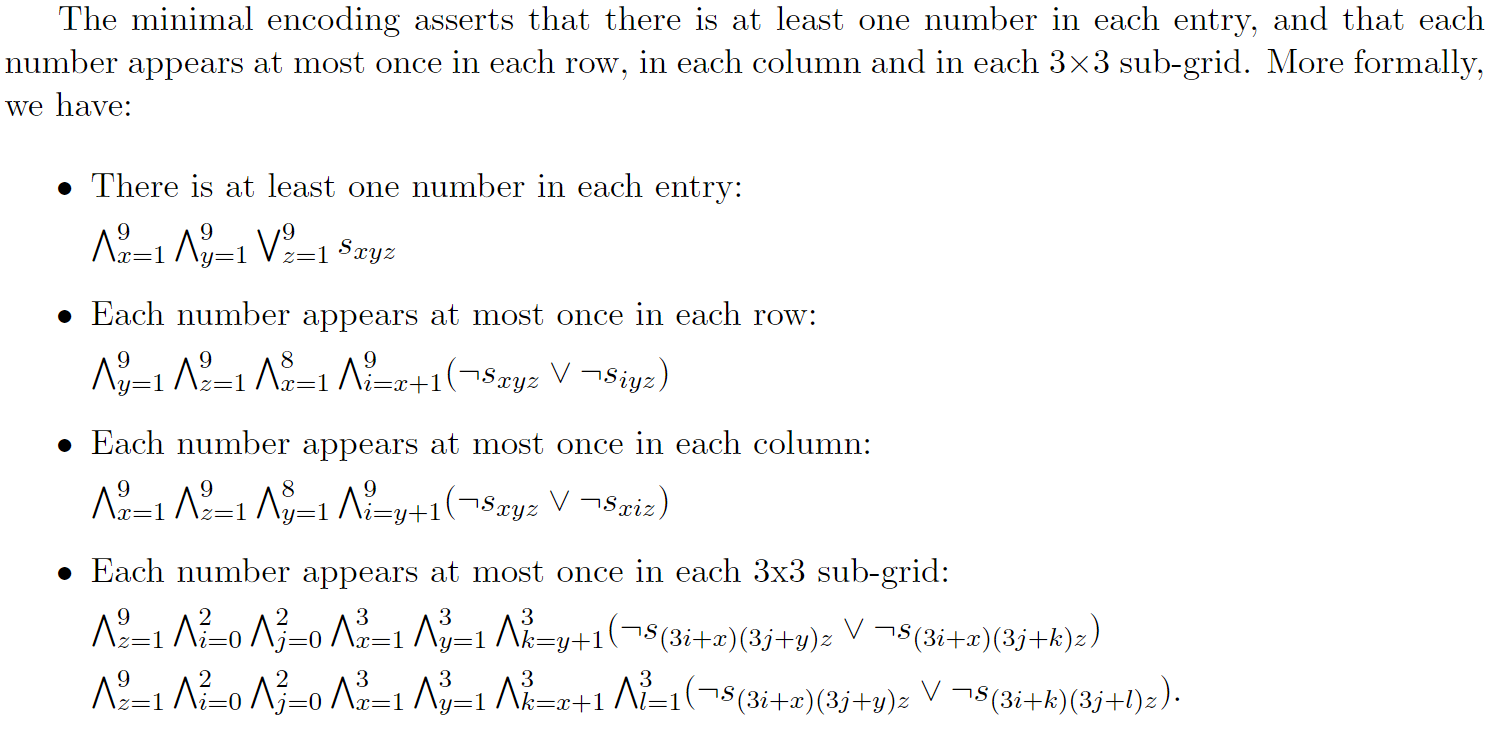
Example: Sudoku problem
Article: Sudoku as a SAT Problem
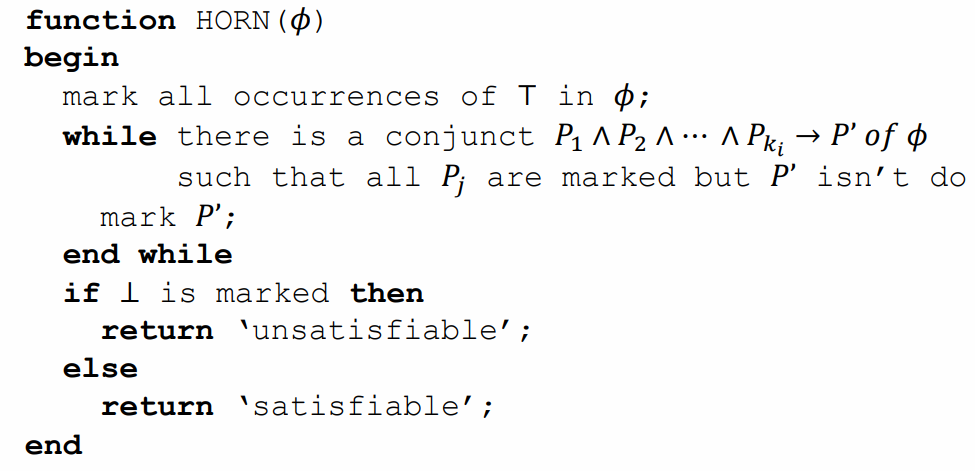
Horn clauses and satisfiability