English Article Sentences
Reading List:
- The most common habits form more than 200 English papers written by graduate Chinese engineering students
- Science research writing: for non-native speakers of English
The Most Common Habits from English Papers written by Chinese Students
a, an, the
- "A" and "An" are indefinite articles
- "the" is a definite article
Very long sentences
Long sentences can be avoided by limiting each sentence to one or two topics. Semicolons should be used where the writer really wants to emphasize the relationship between ideas.
Prefacing the main idea of a sentence by stating the purpose, location or reason first
Bring the main idea to the beginning of the sentence stating any locations, reasons, etc., afterwards.
Tendency of placing phrases which indicate time at the beginning of a sentence
Placing the most important subject at the beginning of the sentence for emphasis
which/that
The noun to which "which" refers is not specific, causing confusion.
Respectively and respective
"Respectively" is usually at the end of the sentence. Mentioning the order must be important to the meaning of the sentence otherwise it is not used.
"In this paper", "in this study"
"In this paper" are reserved for primarily two uses
- In the introduction and conclusion to emphasize the content of the paper.
- In the body of the paper, after referring to work not done by the author such as in other journal articles or in standard.
"In this paper" can be replaced by "In this study".
Numbers and Equations
Arabic numerals should never be used at the beginning of sentences. It should be used to give data in technical papers, however they should not be used to give general information.
Equations should be introduced as much as possible, not inserted in place of words.
Format
- Paragraphs: All paragraphs start on a new line with an indent of about one inch or with an extra line between the two paragraphs. A paragraph can not be preceded by a single sentence on a single line.
- Figure and Table: Abbreviations are not used at the beginning of sentences and a space belongs between the word/ abbreviation and the number, e.g., Fig. 6
- Capitals: Capitals are not in the middle of the sentence.
"such as" and "etc."
- "Such as" means "for example" and implies that an incomplete list will follow.
- "etc." means "and so on" and is used at the end of a list to show it not complete.
- Using "such as" and "etc." together is redundant.
Some words do not need an "s"
- literature
- equipment
- staff
- faculty
Avoid redundancy in the following types of phrases
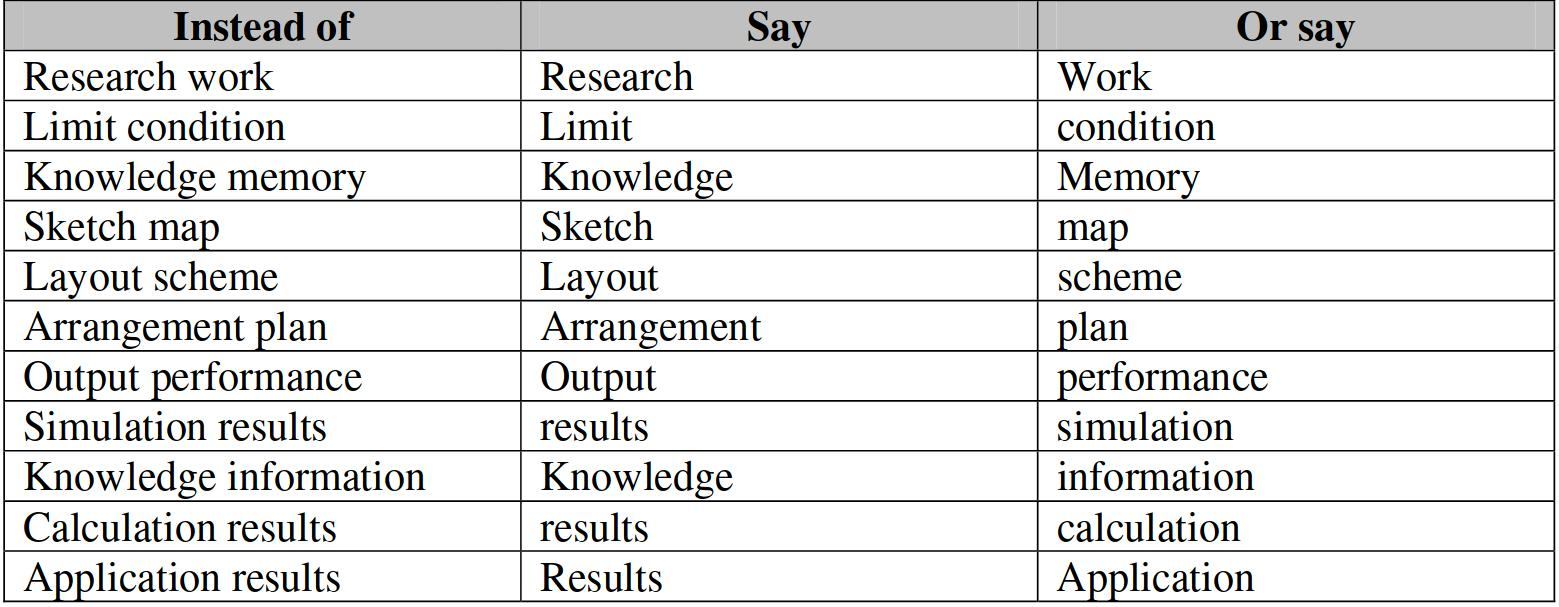

Others
- Never begin an English sentence with abbreviations and Arabic numerals such as Fig. and 8. Instead write Figure and Eight.
- Do not write "by this way". Instead write "by doing this", or "using this method"
- Never write "How to..." at the beginning of a sentence.
- Do write "the result are shown in Figure 2". Do not write "the result are showed as Figure 2".
- Italicize variables appearing in the text to differentiate them from words. This is especially important when the variables are English alphabets. Write "The graph shows i, a, and C as a function of time". Do not write "The graph shows t, a, and C as a function of time".
- Refrain from using the word obviously in a technical paper in the following way
- Obviously, detecting regimes by means of PMH maps is a novel method. NO
- Detecting regimes by means of PMH maps is a novel method. YES
- Avoid overusing the phrases "that is to say" and "namely". Instead, try to convey your meaning in one sentence.
- Do not use "too" at the end of a written sentence, especially in a technical paper.
Phases
- Suffice it to say, ... 一言以蔽之,……
- be attributed to 归因于
- xx validity threats concern xx xx有效性威胁涉及xx
- Per the usual terminology, ... 按照通常的术语,……
- There may exist an inherent bias towards ...
- It is a significant threat to the validity of ...
Words
| Word | Translation | Example |
|---|---|---|
| realm | 领域 | the software engineering realm |
| proliferation | 增殖 | the proliferation of machine learning |
| indispensable | 必不可少的 | |
| prerequisite | 先决条件 | |
| notably | 尤其 | |
| at scale | 大规模 | Towards automating code review at scale |
| rationale | 理由 | the rationale behind this approach is ... |
| leverage | 利用 | the information that an model could leverage to do sth. |
| MOKA leverages the ability to observe a large number of interactions to do sth. | ||
| intuitively | 直觉地 | |
| inform | 提供 | Our findings can inform future research in this area and ... |
| to this end | 为此 | |
| error prone | 容易出错的 | |
| sophisicated | 复杂的 | |
| obstacles | 障碍 | ... indicates that there are further obstacles to achieving high coverage |
| albeit | 尽管 | ..., albeit some promising techiniques have been developed. |
| coarse-grained | 粗粒度的 | |
| fine-grained | 细粒度的 | |